Discover the key properties, industrial applications and selection points of PTFE dispersion. Learn how high-quality PTFE aqueous dispersion helps improve fiberglass impregnation, cookware coatings, industrial spray coatings and other high-performance fluoropolymer applications.
In the world of high-performance materials, few substances offer the versatility and resilience of Polytetrafluoroethylene (PTFE). However, for manufacturers in the textile, cookware, and industrial coating sectors, the challenge lies not just in choosing PTFE, but in selecting the right delivery system.
This water-based system allows for the unique properties of PTFE—such as extreme chemical resistance, low friction, and high thermal stability—to be applied to substrates that cannot withstand traditional extrusion processes. Whether you are impregnating glass fiber for architectural fabrics or formulating premium non-stick cookware, understanding the quality indicators of PTFE dispersion is critical for your product's success.
What is PTFE Dispersion?
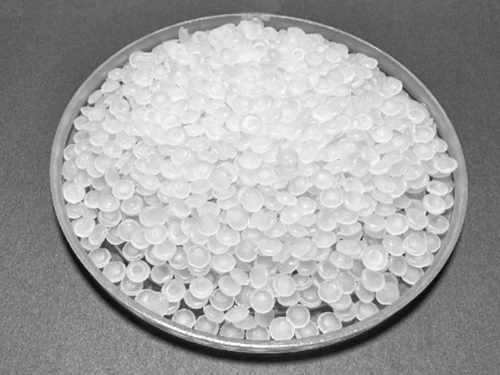
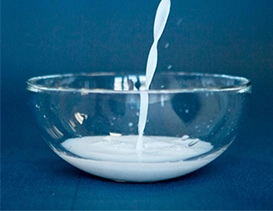
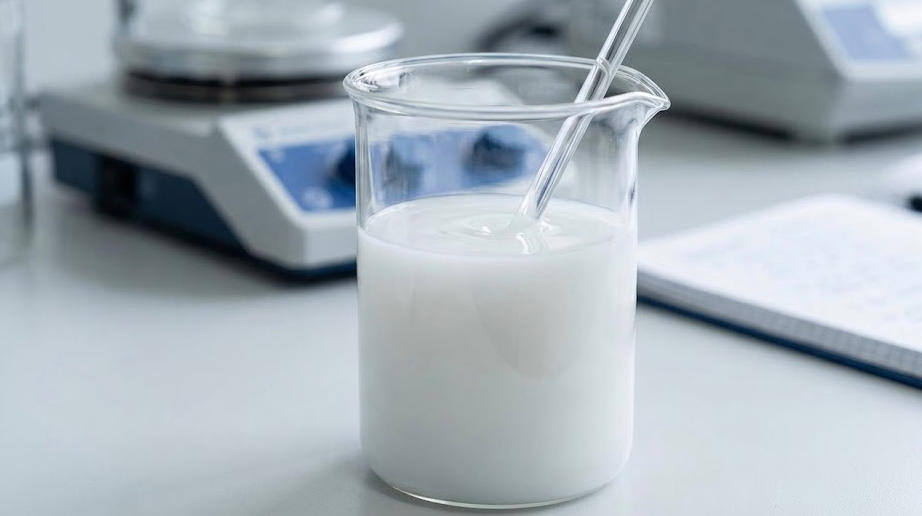
PTFE Dispersion is a milky-white, aqueous fluid consisting of very small PTFE particles stabilized in water by non-ionic surfactants. Unlike granular PTFE, which is molded, dispersions are designed for liquid-based processing methods such as dipping, spraying, or brushing.
Key characteristics typically include:
Solid Content: Usually ranging between 50% to 60%.
Particle Size: Extremely fine particles (often 0.2 – 0.3 microns) ensuring uniform coverage.
Stability: High-quality dispersions resist premature settling, ensuring consistent application.
Critical Applications in Modern Manufacturing
Why are engineers and procurement managers turning to PTFE dispersions? The answer lies in its ability to impart "Teflon-like" properties to complex shapes and diverse materials.
1. Glass Fiber Impregnation
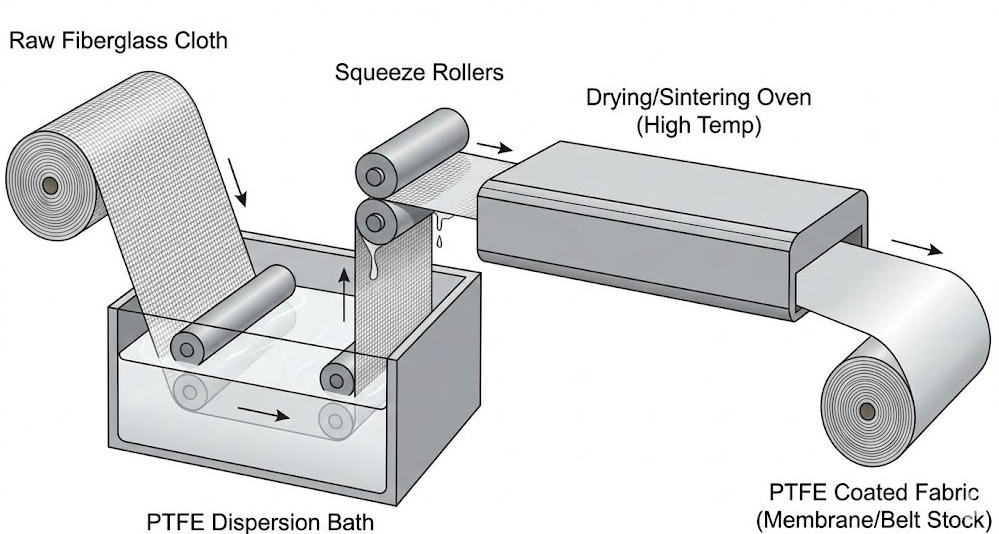
This is one of the most significant industrial uses. By passing fiberglass cloth through a PTFE dispersion bath, manufacturers create materials used in:
A.Architectural membranes (stadium roofs).
B.High-temperature conveyor belts.
C.Electrical insulation tapes.
The dispersion must possess excellent wetting properties to penetrate the fiber bundles effectively, ensuring the final composite is moisture-resistant and durable.
2. Cookware and Bakeware Coatings
For the non-stick coating industry, PTFE dispersion serves as the critical topcoat or intermediate layer. It provides the essential release properties that consumers demand.
Benefit: Provides a low coefficient of friction and high heat resistance (up to 260°C).

3. Industrial Spray Coatings
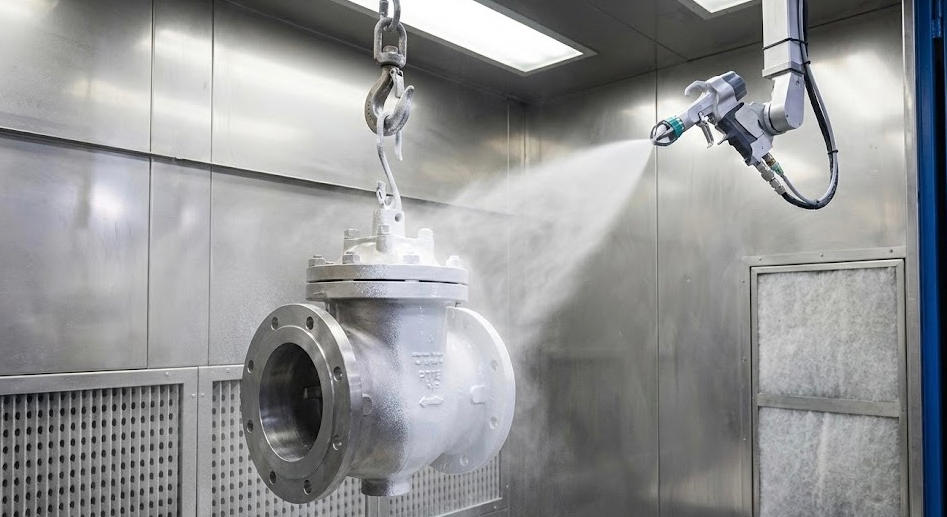
From chemical tanks to automotive components, PTFE dispersions are used to create anti-corrosive and low-friction barriers on metal surfaces.
The table below summarizes how PTFE dispersion supports different manufacturing applications and what buyers should focus on when selecting a suitable grade.
| Application | Main Function of PTFE Dispersion | Buyer’s Selection Focus |
| Glass Fiber Impregnation | Improves heat resistance, moisture resistance and durability of fiberglass composites | Wetting ability, penetration, particle size and dispersion stability |
| Cookware and Bakeware Coatings | Provides non-stick release, low friction and heat resistance | Film-forming ability, purity, surface smoothness and coating consistency |
| Industrial Spray Coatings | Creates anti-corrosive, low-friction and anti-stick surfaces on metal parts | Viscosity, sintering behavior, coating adhesion and surface uniformity |
| Electrical Insulation Materials | Enhances dielectric properties, heat resistance and chemical stability | Purity, coating uniformity and long-term stability |
| Packing, Yarns and Porous Materials | Improves lubricity, chemical resistance and hydrophobic performance | Permeability, wetting ability and repeated impregnation performance |
How to Select the Right PTFE Dispersion
Not all dispersions are created equal. When evaluating a supplier or a specific grade (like our JF-4D series), consider the following technical metrics:
Surfactant Type and Content: This affects the wetting ability and the "sintering" process. Optimized surfactant levels prevent cracks during drying.
Settling Stability: A stable dispersion reduces waste and ensures process consistency without constant aggressive agitation.
Purity: For electronic or food-contact applications, the purity of the resin is non-negotiable.
Common Problems When Using PTFE Dispersion
In real production, coating defects are often caused by a mismatch between the PTFE dispersion grade and the processing conditions. Understanding common problems can help manufacturers avoid unnecessary waste.
Uneven coating surface may be caused by poor dispersion stability, unsuitable viscosity or insufficient mixing.
Poor fiberglass penetration may be caused by weak wetting ability or an unsuitable grade for impregnation.
Cracking after drying or sintering may be related to excessive coating thickness, improper drying conditions or incompatible formulation.
Settling during storage may happen when the dispersion is stored for too long or handled incorrectly.
Inconsistent gloss may be caused by unsuitable particle size, poor film formation or mismatched sintering conditions.
Before bulk purchasing, buyers should confirm the substrate type, coating method, drying temperature, sintering conditions, target coating weight and final application environment.
Why Choose Our PTFE Dispersion Solutions?
As one of the leading fluoropolymers manufacturers, FLUORINCHEM understands that material consistency determines your production yield. Our PTFE Dispersion products are engineered for:
Superior Stability: Minimized settling for easier storage and handling.
Excellent Film-Forming: Creating smooth, crack-free finishes after sintering.
Versatility: Compatible with various impregnation and coating processes.
We strictly control the particle size distribution to ensure that whether you are coating delicate glass fibers or robust metal parts, the result is uniform and reliable.
Choosing the right raw material is the first step toward product excellence. PTFE Dispersion offers a unique combination of thermal, chemical, and electrical properties that can elevate your product's performance.
Ready to optimize your production? Contact our technical team today to request a Technical Data Sheet (TDS) or a sample of our high-performance PTFE Dispersion. Let's engineer the future of materials together.
FAQ About PTFE Dispersion
What is PTFE dispersion used for?
PTFE dispersion is used for fiberglass impregnation, cookware coatings, industrial spray coatings, yarn treatment, packing impregnation, high-temperature fabrics, electrical insulation materials and other coating or impregnation applications.
What is the difference between PTFE dispersion and PTFE powder?
PTFE dispersion is a water-based liquid system used for dipping, spraying, brushing and impregnation. PTFE powder is mainly used for molding, extrusion or compounding. The right choice depends on the processing method and final product form.
Is PTFE aqueous dispersion suitable for fiberglass cloth?
Yes. PTFE aqueous dispersion is widely used for fiberglass cloth impregnation. It helps produce PTFE-coated glass fabric for conveyor belts, architectural membranes, release sheets, insulation materials and high-temperature fabrics.
Why is solid content important in PTFE dispersion?
Solid content affects coating thickness, material consumption, drying behavior and final PTFE loading on the substrate. A suitable solid content helps balance production efficiency and coating performance.
Can PTFE dispersion be used for non-stick cookware coating?
Yes. PTFE dispersion is commonly used in non-stick cookware and bakeware coating systems. It helps provide low-friction, easy-release and heat-resistant surface properties.
How should manufacturers choose a PTFE dispersion supplier?
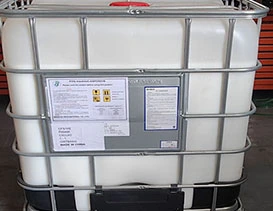
Manufacturers should choose a supplier that can provide stable quality, clear technical data, sample support, application guidance and consistent bulk supply. For industrial coating and impregnation, technical matching is often more important than simply comparing price.
A Deep Dive into